Friday, January 27, 2012

Living in a Bird House

A common wintertime sight from my office window.
Relocating to Atlanta, Georgia, I never imagined that I was moving to a place where I would routinely be awakened by birdsongs and calls.  While Atlanta is certainly urban it is also filled with mature trees, especially in old neighborhoods like mine.  My bedroom and office are on the second floor, which brings me closer to the tree canopy and to the birds and their many activities.

In fall and winter, I enjoy the luxury of leaving the door to the sleeping porch open at night.  My ideal sleeping conditions are fresh air, a cool head, and nest of warmth beneath a thick down comforter.  From this pinnacle of coziness, I have woken in the night to sounds of barred owls calling to one another.  Who-cooks-for-you, who-cooks-for-you-all?  And then the female’s response ending with an extended, gurgling vibrato you-allllllllll.  There is at least one very active pair in my neighborhood, and I have heard them during evening walks calling to one another as they move from tree to tree.  I’ve even seen them in flight, one following closely behind the other.  Sometimes I don’t even need an open window to hear the owls call, but when I do, I generally stop what I am doing and step outside to listen and maybe catch a glimpse of this affectionate pair.

In the springtime, there is no sleeping in.  One morning I woke up laughing because of the sheer cacophony of bird noises.  Here’s a list of the birds I am pretty sure I heard:
Cardinals: Very insistent, somewhat mechanical and certainly repetitive tik.  They have other songs, but they love this one.
Robins have a rich, fruity voice to my ear.  Very dignified.  But in the mornings they seem moved to a truly hilarious chortle. 
Phoebes position themselves on the peaks of our roof and call out their own names, FEE-bee, FEE-b-be-be.  Just beneath them, under the eaves, are the beams on which they build their nests.  In fact, although it’s winter I can see a mud and stick nest above my office window.  Phoebe’s reuse their nests, and come spring there will be a tail of the nesting mother sticking out from the nest, followed by the rasping noises of the babies when the harried parents approach with that moment’s meal.
Carolina Wrens:  Fussy, territorial and exceptionally LOUD.  That such decibels come out of this tiny bird is truly miraculous.  If you were trapped in a room with a Carolina wren, I imagine you would emerge with a severe headache and measurable hearing loss.  The wren’s songs are ubiquitous in my neighborhood: TEA-KETTLE! TEA-KETTLE! TEA-KETTLE!  And CHO-WE! CHO-WE CHO-WE!  Or, when feeling especially extravagant, the three syllable LIB-ER-TY! LIB-ER-TY! LIB-ER-TY!  Always in all-caps with exclamation points. 
More birds than this were surely involved in that morning’s riot, and I look forward to identifying more of my early-morning songsters this coming spring.
For now, I am enjoying the enormous flocks of Red-winged Blackbirds that visit the neighborhood.  Agelaius phoeniceus is the species' scientific name, Aeglaius being a Greek word meaning "flocking." They swoop in, black as holes torn in the sky, and bring with them their screechy chatter.  Suddenly its as if I live beneath an enormous swing set, making the sound of a thousand rusty swings. Sometimes I can catch a glimpse of a male's red and gold shoulder patch. 
Lots of birds around here flock in the winter, for the safety of a crowd and improved chances of finding food.  Robins do the same thing, and songbirds make up mixed flocks of chickadees, kinglets, nuthatches and titmice.[i]  They forage together and look out for predators, the latter being of no small consideration.  I’ve already mentioned owls, but lots other raptors live in the neighborhood: I have seen sharp shined hawks and red-tailed hawks, often with fresh-caught meals in their talons.  Jays and crows are also dangerous to small birds.  Peregrine falcons are said to nest in downtown Atlanta.  Really, it’s no surprise that the local sports teams are named after birds: the Hawks, the Falcons, and (until last year) the Thrashers are all hometown teams. 
The one birdsong I cannot abide is that of the Mourning Dove.  And lately a dove has been sitting in a tree near the house cooing its mournful oh-woe-woe-woe.  This doleful repetition depresses and enrages me.  I want to throw a boot at the bird and shout, For God’s sake, go away! Or I WILL GIVE YOU SOMETHING TO CRY ABOUT!  And should the day come that I unleash this outburst, the Carolina Wren will have nothing on me.


Kroodsma, Donald.  The Backyard Birdsong Guide (Eastern and Central North America).  Bellevue, Washington: Becker&mayer, 2008.

Parrish, John, et al.  Birds of Georgia. Auburn, Washington: Lone Pine Publishing, 2006.

Friday, January 20, 2012

The Death of Big Gulp

Sarracenia leucophylla blooming in the Conservation Gardens at the Atlanta Botanical Garden.
Sometimes as a volunteer at the Atlanta Botanical Garden, you’re given jobs to more or less get you out of the way.  I don’t begrudge this, especially on such a beautiful morning.  The potting benches inside were full, so my sister volunteers and I were assigned to work on the Sarracenia growing behind the greenhouses.  They had accumulated more than their portion of weeds and spent growth. Johnette, Jo Ann and I were on the job!  David Ruland also instructed us to be especially pitiless with pitcherplants showing signs of Exyra moth infestation.      
Jo Ann Bertrand and Johnette Brosewood at work behind the main greenhouses at the Atlanta Botanical Garden.
Pitcherplant Moths    Pitcherplant moths can do what no other insect can:  Walk both down and up the slippery walls inside the pitchers.[i]  Young moth caterpillars feed around the pitcher, girdling it so that it topples over. Older Exyra caterpillars weave a silk roof at the mouth of the pitcher.  Almost all the plants we worked on were white-top pitcherplants (Sarracenia leucophylla), so I believe we were encountering the effects of Exyra semicrocea. We saw doubled-over pitchers and also the drainage holes that the more mature caterpillars make to prevent flooding while they pupate.   Exyra ridingsii are only found in the yellow pitcherplant (Sarracenia flava), and Exyra fax colonizes just purple pitcherplants (Sarracenia purpurea).[ii]
Drainage hole likely made by Exyra catepillar.
Order from Chaos
There is something so satisfying about taking a pot that is full of weeds and spent growth and cleaning in up so that it contains only the desired plant species looking its best.  Here are some of the botanical makeovers we performed.
Before
After
[If I could figure out how to put these before/after pics side-by-side I would.]
Before
After
Johnette Brosewood is the most experienced volunteer when it comes to working with pitcherplants.  She shepherds them through every stage of life, and I am learning how to care for pitcherplants by working alongside Johnette and Jo Ann. And we have our work cut out for us with a greenhouse full of Sarracenia.  Sometimes I feel like a member of the paint crew on the Golden Gate Bridge:  Once we’ve dragged our brushes over the entire bridge, we cross and start all over again, only in our cases, repotting, weeding, top-dressing and pruning.
Conservation Greenhouse
Why does ABG have so many Sarracenia?   Pitcherplant habitat is some of the most endangered habit in Georgia (and elsewhere).  Pitcherplants grew throughout the Southeast, but land conversion into agricultural fields and residential and commercial developments, fire suppression, and invasive species have drastically cut their numbers.  In fact, in Georgia, pitcherplant bogs have been eradicated from the Piedmont and nearly eradicated from the Blue Ridge Mountains.[iii]
The Sarracenia in the Conservation Greenhouse are a living gene bank of plants grown from seed collected from pitcherplants in all the remaining mountain bogs.  Should something happen to the plants in the wild we have back up plants.  Meanwhile, ABG and its conservation partners (government agencies, academic and botanical institutions, and landowners) work to restore and maintain their natural habitat. 
The Death of Big Gulp One of the white-top pitcherplants stood out among the rest.  It was considerably larger and whiter than its peers, and the mouth of its pitcher formed a yawning maw.  Many of us had stepped out behind the greenhouse just to marvel at this specimen.  I named it Big Gulp.  At a certain point in our labors I looked for Big Gulp and didn’t see him (if I can give it a name, I can give it a gender).  
Big gulp, before the tragic event.
Alarmed, Johnette fished through the bin where we tossed our cuttings and found the decapitated Big Gulp.  She had seen the drainage hole and simply snipped not realizing she had cut down our mascot.  As a joke, I put a stick into the bottom half of the cut pitcher so that we could stake Big Gulp back on.  And I teased Johnette, calling her Black Thumbs.
Big Gulp had his revenge though.  His oversized-gullet was so full of decaying insect carcasses that once opened, he released a terrific smell. And a mass of red-eyed flesh flies descended on his remains.  
A chagrined Johnette

[i] Folkerts, Debbie.  “EPSN Science Fact: Insect and Pitcherplant Interactions.  Insect Profiles by Dr. Debbie Folkerts, Auburn University.” http://ebookbrowse.com/epsn-science-facts-insect-and-pitcherplant-interactions-pdf-d57134580
[ii] Ibid.
[iii] Chafin, Linda G. Field Guide to the Rare Plants of Georgia. Athens: University of Georgia Press, 2007. P. 444.

Friday, January 13, 2012

The Power of the Shrinking Viola

Surely the most lugubrious time of year is the end of the growing season.  In Atlanta, this is when pansies overtake every garden center and nursery.  Row after row of little Victorian faces peer up at me, like too many orphans.  Until recently I made it my policy to stride past them to where the mulch is kept.
But pansies do have qualities to be admired, one of which was demonstrated to me in the latest cold snap.  While other plants blacken and die during a freeze (my long-lived begonias positively melted), pansies only experience a temporary wilt.  At dawn they may look like they’ve succumbed to the cold, but by noon they are once again lifting their faces to the sun.  
9 am after a night of temperatures in the 20s.
 The secret to the pansy’s resilience is that as the temperature drops, water leaves the plant’s cells and occupies the space between (osmosis).  The moisture left in the cells has a higher concentration of sugars and other molecules, raising the freezing point.  What kills plants in a freeze is ice forming in the cells and rupturing the cell wall, whereas ice between the walls is safe.  With little water in its cells, the pansy goes limp but lives to grow another day.
12 pm and perking up nicely.  I'll water later to aid their rehydration.
It’s not surprising that pansies are so hardy considering that they were bred from wild violets, like the ones that pop up in yards every spring. The lawn maintenance freaks may rain down poisonous showers, but those Johnnies jump up year after year. 
The Development of the Pansy
The modern pansy is a member of the viola family and began life as a pretty little weed known as heartsease (Viola tricolor) found in the fields and hedgerows of England.  Two wealthy plant enthusiast and their gardeners are credited for bringing heartsease into cultivation.  Lady Mary Elizabeth Bennet, with the help of gardener William Richard, began collecting and crossing heartsease.  By 1813 she had a wide variety of plants to introduce to the horticultural world.  At about the same time, Lord Gambier and his gardener William Thompson crossed a yellow viola (Viola lutea) and a wide-petalled pale yellow species, probably of Russian origin (Viola altaica).  Soon florists and nurseries began producing hybrids so that by 1833 gardeners could choose from more than 400 named pansies. Thompson made a career of hybridizing pansies and was known in his day as “The Father of Heartsease.”
Hearstease (Viola tricolor)Photo by
Jörg Hempel (2007)
.
Early pansy breeders were trying for increased sized and a round shape with overlapping petals.  Wild violas like Viola tricolor have dark streaks for nectar guides.  Florists developed the Show Pansy following strict guidelines as to shape, size, and color. The Fancy Pansy amateur gardeners could find easily for sale and required less rigorous tending. That dark blotch at the center of many pansies first appeared as a sport, which was cultivated in Gambier’s garden.  The first pansy with a dark face was released in 1839 with the name of “Medora.”  
The Development Of The Pansy
Flowers (left-top to bottom-right):
Wild 1830, Cultivated 1830
Show Pansy of 1870, Fancy of 1910

“And there is pansies. That's for thoughts.” -- Ophelia
Even before the central dark blotch was a common feature, pansies were thought of as having a face—a pensive one. The name “pansy” is derived from the French word pensée, meaning "thought." For this reason, the pansy was adopted symbol of Freethought, so that members might recognize one another by wearing the flower in their lapels.  And so many nineteenth-century greeting cards feature pansies because they are shorthand for “thinking of you.”

The pansies say, "Thinking of you." The angel implies, "Even after you or I die." 
Love and its Disappointments
Pansies are also associated with love.  Lady Mary Elizabeth Bennet’s collection of heartsease grew in a heart-shaped bed. Another English name for the pansy is “love in idleness,” which suggests the face of a lover whose thoughts have turned to the absent beloved. 

Interestingly, Medora, the name given to the first pansy cultivar with the dark center, is also the name of Byron’s tragic heroine of The Corsair, published with great sensation in 1814.  In the poem, the pirate captain Conrad departs his island hideout to do battle, leaving behind his true love, Medora.  Conrad becomes entangled in saving a harem slave and dithers over murdering his enemy the Pasha.  Gone so long, Medora believes Conrad dead and expires of grief. (Incidentally, Medora is also the middle name of the daughter of Byron’s lover and half sister.)
Long before the Medoras, Ophelia, in her addled state, speaks of pansies: “And there is pansies. That's for thoughts.”  Her own flower she cannot give away, at least not to Hamlet, and the disappointment has unstrung her mind.  Flowers have long been associated with women, with their tenderness and supposed fragility.  Wounded in love they wither and die.  But perhaps the pansies response to cold is the most apt comparison: a temporary wilt.
Pansies are a kind of floral Rorschach.  I used to see their little parti-colored faces as a display of forced gaiety in the face of oncoming winter.  But now I take a few home and plant them in a handful of pots and baskets and am grateful for their cheerful color.

Monday, October 24, 2011

Field Notes--Orchids & Sundews of Tallulah Gorge

Tallulah River as seen from the hydroelectric station.

October 14, 2011
It is just dawn and I am riding in the back seat of the Atlanta Botanical Garden’s Subaru heading toward Tallulah State Park. The conversation up front is making me want to climb out the window.  Matt Richards and Ron Determann, ABG’s Conservatory Director, are talking about the ecological losses Ron has witnessed in 30 years of plant conservation. 

“There aren’t really any natural areas left in Georgia.  Not really,” he says. “Just pockets with refugia of rare plants.”

The main problem, as he sees it, is the heavy use of herbicides used to control weeds along roadsides, under powerlines, and even along paths in natural areas visited by the public.  The method formerly used, which is less destructive, is mowing.   But that takes more people and equipment, plus you have to mow more often than spray—at least initially.  The result, according to Ron, has been the destruction of most roadside ecology. 

Sarracenia leucophylla, Conservation Garden @ ABG
Now, you might not think that native plants, and certainly not rare plants, grow in highway medians or under powerlines, but they do. The white-top pitcher plant (Sarracenia leucophylla) was thought to be extinct in Georgia until it was found growing in a powerline right-of-way in 2000.[i]  Similarly, one of the few Georgia populations of Tennessee yellow-eyed grass (Xyris tennesseensis) clings to the greenspace in a highway off ramp.[ii]   

As counter-intuitive as it seems,  nutrient-poor sites also harbor greater biodiversity.  Repeatedly spraying for weeds builds up decaying vegetation, which enriches the soil making it more hospitable for weedy growth.  So instead of a diverse roadside ecology, you get a few species of invasive weeds growing lush and tall.  Naturally, the invigorated weeds require more frequent of spraying.  And so it goes.

The other nasty side-effect of using herbicides is the harm they can do to amphibians.  Herbicides with surfactants are not to be used in wetlands, but they very often are.  The surfactants clog the breathing pores of frogs and other creatures, killing them.

In addition to weed suppression, herbicides are injected into tree stumps to prevent re-sprouting.  The practice is thought to be safe for the creatures that live around these stumps, but Ron doesn’t think so.  He describes finding skeletons of 30 year-old bog turtles that died after stumps around their habitat had been poisoned.

At this point in the conversation, I can take no more. It’s barely light out, and in the morning I am especially vulnerable to despair.  I pull photos of plants on my phone for Ron and Matt to identify. It’s not that I don’t want to hear it; I just need my doses of toxic knowledge at non-lethal levels.

***

Ron Determann: Conservationist & horticulturalist extraordinaire.
Today we will not be visiting a roadside refugia, but climbing into Tallulah Gorge, one of Georgia’s most beautiful places, to look for the monkeyface orchid (Platanthera integrilabia) and some of its friends.  We hope to collect seed to bring back and grow in the tissue culture lab.  We’ll keep some seed and plants for back up and outplant seedlings to augment the natural population.  Growing things is Ron’s especial gift.  He has brought rare and endangered plants into cultivation that no one else has been able to grow.  The tissue culture lab that Matt runs at ABG is named after Ron.  

The tram making its very slow yet precipitous journey.
The orchids were sighted growing near the floor of the Tallulah gorge, nearly 1,000 feet down, alongside the Tallulah River.  The river is no longer the roaring terror that earned it the name “ the Niagara of the South.”  Dammed in 1913, the Tallulah River’s six falls have been quieted.

Nevertheless, we still have to find a safe place to cross the river to reach the orchids.  Brian Estes of Georgia Power knows just the spot and he's arranged a special treat for us.
Almost there. See the folks at the bottom?
We are taking the a tram that runs strait down the face of the gorge to the hydroelectric station below.  Hiking down would be pleasant, but that would take three hours round trip, leaving less time to hunt orchids.   

Climbing into the tram we are initially cautious of the open doors but are soon hanging out the sides taking photographs of the odd combination of flora growing on the slope:  natives, exotic invasives, and wetland plants taking advantage of the water flowing from tiny leaks in the penstock pipes that take water down into the hydroelectric turbines. 
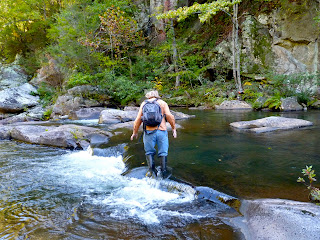
Forging the Tallulah River
Our ride over, we leave the tram and put in earplugs so that we can walk through the noisy power station and begin our final descent into the gorge.  Soon we are scrambling over rocks and through trees and shrubs looking for a shallow place to cross the river.  Brian finds the spot and one-at-a-time we make our way through the water and over the rocks slick with moss. 
We are on the other side less than three minutes before Matt finds orchids.  We collect seed capsules and move to another spot.  The growth of shrubs is dense and the footing is uncertain, and everyone manages to grab hold of poison sumac at one time or another.  Having inadvertently nuzzled the stuff, I have a vision of my face 3 days from now erupting into painful blisters.  

Poison sumac in its autumn colors.

I next see my companions gathered at a seep where water has collected into what looks like a shallow pool but Brian has warned us is actually waist-deep silt.  Matt and Ron collect more seed.  I see Parnassia asarfolia in bloom, which I saw for the first time last week while collecting Isotria with Matt.  We thought we’d have time to stop and take photos on the way out, but no such luck.   
Parnassia asarfolia
While I am carefully photographing the exquisite blossom, the rest of the group continues the ascent.  The next thing I know I am alone.  I start to climb and call, climb and call.  At last I hear an answering voice.  By the time I catch up, I’ve lost my lens cap and some of my composure.  My hair is full of twigs and leaves. 

Everyone is standing around what may be the same seep only much higher up.  Sphagnum moss grows thickly at the edges of the wet rock face, and on the face itself are tiny round-leaf sundews, Drosera rotundifolia.  The red hairs on their leaves glisten with mucilage, a sweet but also sticky substance that lures insects to their doom.   
Sundews appear to be growing in light film on rock face.
Once stuck, the hairs bend inward and the leaf begins to fold over the insect. Meanwhile glands on the hairs secrete enzymes to dissolve and digest the insect.  Several days later, the meal complete, the leaf will unfold, ready to ensnare its next victim.  Carnivorous plants live in nutrient-poor conditions like this seep, catching and eating insects to supplement their diet.

The Drosera rotundifolia growing so abundantly in this seep is the same species of sundew that Charles Darwin prodded with everything but the kitchen sink.  To see what would make the sundew move, Darwin placed in its hairs—he called them tentacles—meat, dead flies, bits of paper, wood, dried moss, sponge, cinders, chalk, wadded strands of hair, and shards of glass.  What he found was that when repeatedly touched by minute objects, the tentacles would invariably enfold the object.  Meat, egg, and, of course, insects the plants retained and flooded with digestive enzymes until consumed. Innutritious material like glass and cinders the leaf released.

(Drosera rotundifolia)
Leaf (enlarged), tentacles on one side inflected over a bit of meat placed on the disc.
 From Charles Darwin's Insectivorous Plants (1875).  Drawing by his son George.
In Darwin's experiments not every touch resulted in movement.  Drops of water and other heavy pressures did not cause the tentacles to bend. Darwin concluded that thanks to this selective sensitivity “the plant is thus saved from much useless movement, as during a high wind the glands can hardly escape being occasionally brushed by the leaves of surrounding plants.”[iii]

Matt pointing to a sundew and not sliding down the cliff.
I did not stop to poke the sundews.  Nor did I look to see what prey they grasped in their hairs.  I concentrated on staying more or less upright.  Ron, however, did slip a few specimens into a bag.

In total we collect seed from five orchid species:
Platanthera integrilabia     Monkeyface orchid
Platanthera clavellata        Small green wood orchid
Pogonia ophioglossoides    Snakemouth orchid
Calopogon tuberosus         Common grass-pink
Malaxis uniflora                 Green adder’s-mouth orchid

Snakemouth orchid, Pogonia ophioglossoides
The snakemouth orchid (Pogonia ophioglossoides ) and the common grass-pink (Calopogon tuberosus) were especially exciting to find growing in Tallulah Gorge.  Both orchids are common in Georgia’s coastal plains, but this is the only known mountain population of each species.   

The seed can be grown into plants, and then the plants can be placed in mountain bogs that the Atlanta Botanical Garden is restoring.  The ideal is to grow material from the recovery location and return the plants to the original site to augment the natural population.  In the absence of such material, you can at least strive for a kind of genetic authenticity by using plants from the same kinds of locations, in this case mountain locations. As Ron says, “We don’t like to put Okefenokee orchids in mountain bogs, even if they are the same species.” 

“I could stay here all day,” Matt enthused.  No doubt he could, but it was time to start heading out.  

Ron with our guide, Brian Estes of Georgia Power

[i] Chafin, Linda G. Field Guide to the Rare Plants of Georgia. Athens: University of Georgia Press, 2007.  p. 446.
[ii] Chafin, Field Guide p. 434.
[iii] Darwin, Charles R. 1875. Insectivorous Plants. London: John Murray. p. 264  http://darwin-online.org.uk/content/frameset?itemID=F1217&viewtype=text&pageseq=1

Sunday, October 9, 2011

Field Notes: Hunting for Orchids and Indian Pipe

October 7, 2011
I am riding north with Matt Richards, the Atlanta Botanical Garden’s Conservation Coordinator and orchid specialist.  We are headed to Georgia’s gold country.  It is also orchid country, where both yellow and pink lady’s-slipper flourish, and where the remaining populations of rare orchids species can be found—if you are lucky.  The orchid we are looking for today is Isotria medeoloides, or small whorled pogonia.  The U.S. Forest Services has been monitoring the plant for the past 15 years, and its numbers have been in steady decline.  
Isotria medeoloides in bloom.  Photo: Dennis D. Horn.
Our first stop is a gas station in Suches, which boasts the highest elevation of any Georgia town (just shy of 3,000 feet).  In my experience, fieldwork meet-ups tend to be at gas stations, which is convenient since you get one last visit to the bathroom and a chance to buy water and other provisions before entering the woods.  Deciduous forests aren’t the greatest for finding secluded spots for a bare-bottomed pee, especially if you are with a group that has split up to search for plants. 
We don’t have to wait at the station for long before Mike Broe arrives.  Mike is a Ph.D. student at Ohio State University working on Indian pipe, a kind of mycotrophic ("fungus feeding") plant that has no chlorophyll and spends most of its life underground. Green plants are called “autotrophs” because they are capable of feeding themselves given sun, water and carbon dioxide.  Mycotrophs take advantage of the symbiotic relationship between trees and mycorrhizal fungi.  Mycorrhizal hyphae (fungal threads) enter into the roots of the trees and the trees benefit from the increased surface area of their root system.  The trees absorb more water and minerals, and the fungus receives nutrients from the tree.  Like a little thief, Indian pipe taps into this symbiotic apparatus, reversing the flow of carbon and other nutrients to meet its own needs.

A more common Indian pipe, Monotropa uniflora, also called Ghost plant.
The only time Indian pipe and other mycotrophic plants are visible is when they flower, pushing mushroom-like through the forest duff.  The kind of Indian pipe that interests Mike is Monotropa hypopitys.  Its flower is a pale creamy white, coral pink or red.  On a recent orchid-seed collecting trip, Matt saw populations of very deep red M. hypopitys similar to ones Mike has observed in Maryland and Ohio.  From his studies of the morphology and DNA of the plant, Mike has reason to believe that this southern population may be a distinct species. When he has looked at specimens under a microscope, Mike has seen white hairs around the stile that are not present in M. hypropitys of the north: “The white hairs are very striking against the red, like Santa’s whiskers.”

Matt (right) showing Mike where we are on the map.  Better than leaving breadcrumbs.
The trail Matt leads us down is densely forested with pine and hemlock and overhung with rhododendron, creating the gloomy atmosphere favored by Monotropa.  It isn’t long before we spot the red flower spikes of M. hypopitys—as it is called for now.  After Mike’s work, it may be assigned a new classification.

M. hypopitys in its red glory.
 Mike is delighted at what he sees.

“Need anything else?  You want help finding your way out when you’re done?” Matt asks before we leave him to it.

“No,” Mike replies, “I’m in hypopitys heaven!”

***
Our next appointment is with Ronnie Ensley, our guide to the area’s Isotria populations.  Ronnie worked for the U.S. Forest Service where his job was to look for federally protected plant species on land slated for logging.  “I was the only one to apply,” Ronnie told me.  “I learned on the job.” 
Matt has great respect for Ronnie.  “There’s a generation gap between guys like Ronnie and me.  He’s gotta be at least 70, and what he knows nobody else does.  When he’s gone, that it.  It’s important to get out there with him and transfer some of that knowledge.”

Our quarry, the orchid Isotria medeoloides.  Can you see it, the light yellow, five-petaled plant in the middle?
Isotria flowered back in May, so we are looking for what remains of the plant, hopefully with seed capsules intact. It’s a small plant and is especially hard to spot in its spent state.  Also, Isotria often grows among wild cucumber, which has a very similar look.  Not every plant flowers, and in a poor growing season, fewer plants come up at all.

The site of our first search for Isotria.
The first location Ronnie takes us to is a lovely little creek-side slope.  After a search we find lots of wild cucumber and only two Isotria, neither of which have seed capsules and don’t look like they ever did.  We also find a three birds orchid, Triphora trianthophora, which bloomed somewhere between July and September.  The flowers last just a few days and are open only from midmorning to midafternoon.  Triphora in bloom is a truly rare sight.

Three birds orchid with seed capsules.
We drive to another spot and park.  Here we put on orange vests since it’s hunting season.  Rifles are banging away in the distance.  We hike into what was once a road, which is now over-grown with shrubs, sapling tulip poplars and baby hemlock.  Ronnie takes a turn off the path and heads into the forest.  How does he know where to turn?  He doesn’t use GPS or look at a map he’s marked.  Matt and I are baffled.  He just walks right up to the spot where he’s seen Istoria in the past. 
After a bit of a search, we find an Isotria with seed capsules intact. 
“You’re gonna decapitate it, aren’t you?” Ronnie asks Matt.  “I can’t watch.”

Our guide, Ronnie Ensley in the foreground.
Matt assures him that he’ll only keep around 10% of the seed.  The rest he’ll disperse in the same spot, some as raw seed and some in prepared packets to bait the fungus Isotria needs to grow.  What Matt keeps he will try to grow in the tissue culture lab back at the garden, and some will simply be stored as back up against extinction. 
At the last site I actually find an Isotria with seed.  I am quite pleased with myself since it is particularly ratty and difficult to see.  I consider myself extremely lucky to be able to come along on fieldwork.  As I see it, my first duty is not to get in the way.  My second is to be a pleasant traveling companion.  I feel especially glad when I can actually be of some use. 

Our last Isotria of the day and my first find.
 We hike back to our vehicles and part ways with Ronnie.  It’s been a good day.  We found what we were looking for—which happens as often as not in Matt’s line of work—and we collected seed. As we motor through the countryside, Matt grips the wheel and exclaims, “There is no way I could have found those plants without Ronnie.”

Wednesday, April 27, 2011

Freya & the Phoebes

I know this is floraphile, but occasionally I have to report on fauna.  
A pair of Eastern phoebes set up housekeeping in the eaves just above my office window, a circumstance both enchanting and stressful.  
The nest:  a sturdy structure mostly of mud.
Being flycatchers, Phoebes go from perch, to a quick flit, to a mouthful of insects in seconds.  They are like bats without the nighttime equipment, or swallows minus the acrobatic soaring.  Phoebes are small, unassuming birds, but doughty.  One afternoon I saw a mockingbird uncomfortably near the nest going through its repertoire of aggressive calls.  Undaunted, the phoebe planted himself just feet from the mockingbird, his tiny chest hugely puffed out.
The redoubtable phoebe outside my window.
The stressful bit has been my cat Freya’s too-avid interest in the birds.  Sitting transfixed in the window seat is acceptable; climbing the screen to get a closer look is too much. 
Tireless ornithologist?  I think not.
Bad animal.
As a deterrent I kept a spray bottle on the desk, but Freya just couldn’t help herself.  A phoebe would come flying in and she’d be up the screen like a caged monkey.  I’d squirt Freya and she’d run into the hall, where she’d regard me with hard-eyed outrage.
They call me The Enforcer.
I was afraid that the birds might abandon the nest, so Freya was banished from my office.  She now lodges her complaints at the closed door.  Alternately Freya assures me that she just wants to put the phoebes in her mouth.  Just for a minute.  No harm done.   
For a time I couldn’t see the mother’s tail poking out from the nest, nor did I hear any babies.  I feared the worst.   So it was with great relief that I saw the parents, their beaks stuffed with insects, fly into the nest, and then heard the screechy delight of baby birds.